Quick Summary
- Client
- Visayas-based agricultural trading company — nationwide field operations
- Problem
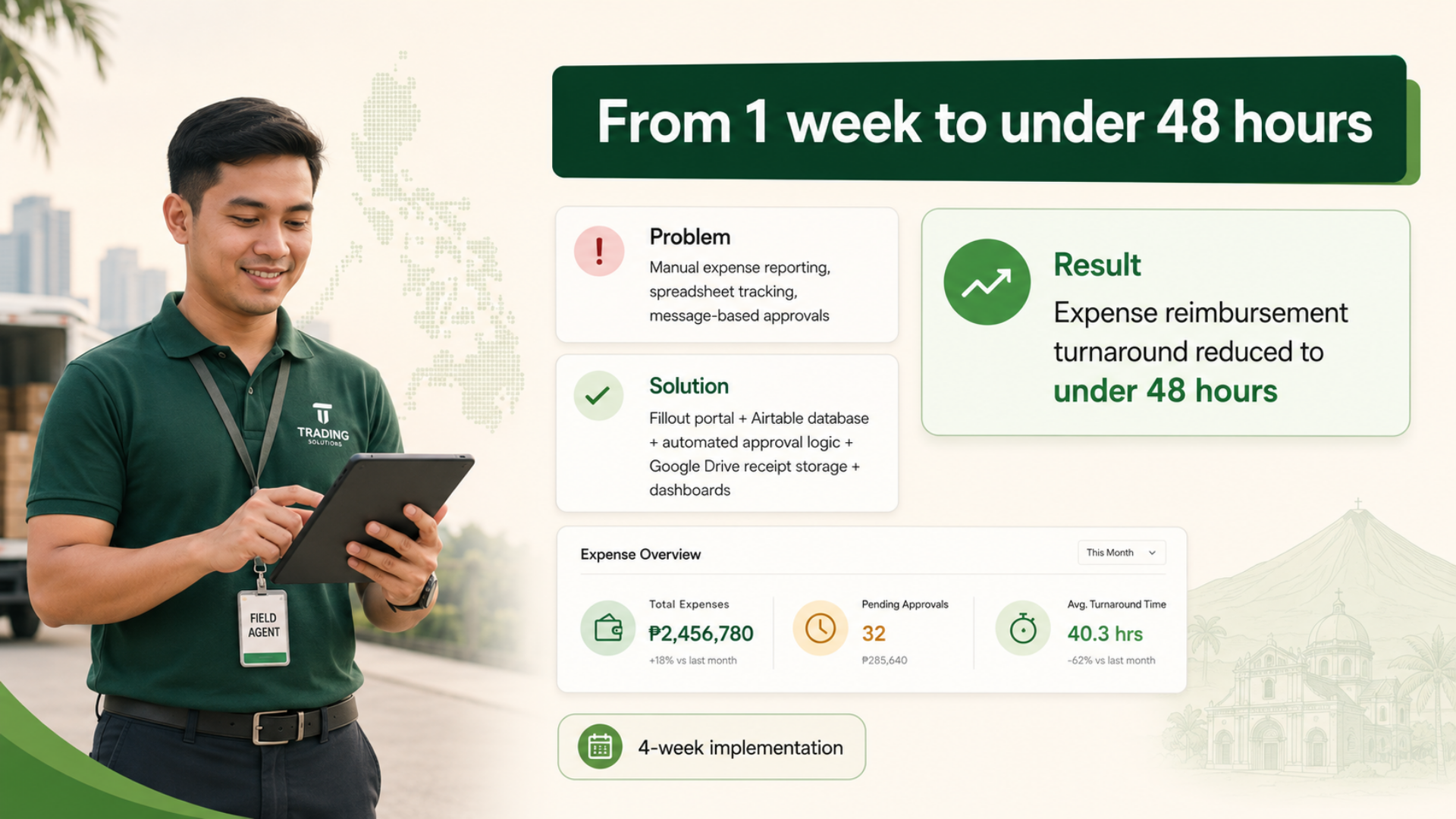
- Manual expense reporting took up to one week from submission to reimbursement
- Solution
- Structured submission portal, automated approval logic, centralized database, finance dashboards
- Result
- Reimbursement turnaround reduced from one week to under 48 hours
- Timeline
- 4 weeks (part of a larger multi-phase engagement)
- Stack
- Fillout · Airtable · Airtable Scripts · Zapier · Google Drive
A Visayas-based agricultural trading company with nationwide field operations replaced manual expense tracking with a structured portal and automated approval logic.
The Problem: A Week-Long Paper Trail
When your field sales team files expense reports manually — receipts photographed and sent over group chat, amounts typed into spreadsheets, approvals chased through messages — the obvious cost is time. But the real cost is what that time blocks.
Finance can't close monthly reports cleanly because expense data trickles in inconsistently. Management can't see real-time spend by region because the data lives in someone's inbox. Field agents delay submissions because the process is tedious, which delays their own reimbursements — and that quietly erodes trust between headquarters and the field.
This is exactly what one Philippine agricultural trading company was dealing with. A nationwide field sales team submitting expenses manually, with reimbursement cycles stretching to a full week.
Before the Build
- Field agents compiled receipts and sent them via spreadsheet or group chat
- Finance manually checked each submission against internal rules and thresholds
- Approved expenses were re-entered into a separate tracking sheet for reimbursement
- The full cycle — submission to reimbursement — took up to one week
- During peak periods with agents across multiple regions, backlogs were common
What Was Built: A Four-Layer Expense System
The replacement system has four layers, each handling a specific job. No single tool is overloaded, and no data lives in only one place.
Submission Portal
A guided, step-by-step web form where field agents submit each expense entry with a receipt photo, category, amount, date, and justification. The form enforces completeness — required fields, image quality reminders, receipt detail checks — so finance receives clean submissions instead of chasing corrections after the fact. Agents access it from any device: phone between customer visits, tablet at end of day, laptop at home.
Centralized Database
Every submission flows into a structured database that serves as the single source of truth. Records are automatically linked to the submitting agent, their region, and the relevant finance rules. No manual data entry. No copy-paste between sheets.
Automated Approval Logic
A scripting layer evaluates each expense against configurable finance rules — category thresholds, approval requirements, auto-approval conditions. Expenses that meet the criteria are approved automatically. Those requiring review are routed to the appropriate approver with all context attached. Approved or rejected, the field agent gets notified. Finance rules can be updated directly in the database without touching the automation — so when policies change, the system adapts without a rebuild.
Finance Visibility and Storage
Approved expenses sync automatically to a finance-accessible view for reimbursement processing. Receipt images are organized by employee and month in cloud storage, linked back to each record. Management dashboards show real-time expense data by region, category, and period — no more waiting for end-of-month consolidation.
The Stack


What Changed
The client's National Field Operations Head shared this after the system had been in use for several months:
The improvement from one week to 48 hours wasn't the result of working faster. It was the result of eliminating the steps that shouldn't have existed in the first place: manual data entry, approval chasing, receipt re-requests, spreadsheet consolidation. The system didn't speed up the old process — it replaced it with one that has fewer steps.
We had a problem with daily reports, expense tracking, and streamlined planning of short term activities. We already had an internal system for these but they were not efficient and connected. Most of these processes were done manually on Excel or Google Sheets, which were not easy to handle as top management.
Out of all the changes, one big relief are the expense tracking and reimbursements. Previously it was done all manually, which would take maybe one week to complete from the start of creating the expense report to the reimbursement from head office. Now with this new system, it would take at most 48 hours.
I would highly recommend taking a look at a system like this, since it overall reduces the need of manual input. Each company would require a unique system, which suits specific problems and needs. The beauty of building a system like this is that it is highly customizable and it can adapt to all use cases — for any kind of industry.
What Made This Work
Three design decisions that mattered more than the tools:
The portal was designed around how the team already works
Mobile-first, between customer visits, with photo-based receipt capture instead of typed entries. Adoption was high because the system met the team where they already were — not where headquarters wished they were.
Finance rules live in the database, not in the code
When approval thresholds change or new expense categories are added, the finance team updates a reference table directly. No developer needed, no rebuild required. The system adapts to policy changes without a single line of code being touched.
Emails confirm, dashboards inform, Drive stores
Every layer has one job. Agents get confirmation emails. Management gets dashboards. Finance gets organized receipt folders. No single tool is overloaded, and no data lives in only one place.
Is Your Team Still Tracking Expenses Manually?
If your field team is submitting expenses through group chats, spreadsheets, or email — and your finance team is manually checking each one — the friction you're feeling isn't a people problem. It's a systems problem.
Running on manual workarounds?
One discovery call and you'll know what's worth automating in your operation, what isn't, and what a working system would look like.